I Built a Local News Website
Around six years ago, I moved to Boise, Idaho. It just so happened to be right about the time COVID was starting to shut down the nation and the world, more strictly in some places, more loosely in others. It was a strange time to move anywhere, but it was an especially strange time to move from the only region I had really known into a place that felt completely unfamiliar.
I had spent the vast majority of my life in Western Washington. I was used to Mount Rainier, evergreen trees, gray skies, and rain that seemed to exist less as a weather event and more as a permanent condition of life. I knew where everything was. I knew the coffee shops, the stores, the back roads, the highways, and the places you only know about because you grew up near them or got lost there enough times to remember. I could get to downtown Seattle without thinking about it, and I could find my way to random little towns up north, including strange little places like Point Roberts, which feels like the kind of place only a handful of people know exists.
Then I moved to Boise, and almost immediately realized how much I had taken that familiarity for granted.
Boise is beautiful, but it is beautiful in a very different way than Western Washington. It is drier, warmer, and a whole lot browner, at least when you first arrive and are still mentally comparing everything to cedar trees and moss. There are mountains and trails and plenty of beautiful places to explore, especially once you get out of the city and into the more rugged parts of Idaho, but it took time for that landscape to register with me. At first, I mostly felt like a fish out of water.
That feeling was amplified by the timing. Because of COVID, moving to a new place did not come with the normal rhythm of exploring restaurants, wandering into coffee shops, going to events, meeting people, and slowly becoming familiar with the area. Everything was filtered through closures, uncertainty, and the general weirdness of that period. So even after I had technically moved, it took a while before I felt like I had really arrived.
Once things started returning to normal, or at least whatever version of normal we were all trying to piece back together, the feeling became more obvious: I had no idea what anything was here. I did not know what there was to do. I did not know which coffee shops were good. I did not know which trails people liked. I did not know where to go on a Saturday morning, which restaurants people were excited about, or where locals went when they wanted to get out of town for the day.
So I did what most people do. I searched around online. I poked through Google Maps. I tried things at random. Somewhere along the way, I also picked up traditional archery, which has been a lot of fun, especially in a state like Idaho where there is so much public land and so many places to get outside. I even started a small archery channel called Lens & Arrow and posted things like trying an English longbow as a thumb draw archer, because apparently my hobbies have a tendency to turn into websites, videos, or both.
But in the middle of all that exploring, I noticed something interesting. When I wanted to understand what was actually happening around Boise, the first place I thought to look was local news. That seems obvious enough. If you are new to a city and want to know what is happening in that city, local news should be the place to go.
The problem was that most of what I found did not really feel like the city I was trying to get to know.
Local News That Doesn’t Feel Local
This is not meant as a hit piece on local journalism. Local news is expensive to produce, journalism is not cheap, and there is real value in knowing about road closures, city decisions, public safety issues, elections, crime, weather, and everything else that falls under the traditional umbrella of local coverage. I am not saying those things do not matter. They do.
But there is a difference between “this happened in Boise” and “this is what it feels like to live in Boise.”
That is the gap I kept noticing. If you talked to someone who lived here, the conversation usually was not about the same things that appeared on local news sites. People were talking about which hot spring they wanted to visit over the weekend. They were talking about floating the Boise River. They were talking about a new restaurant downtown, a coffee shop they liked, a concert coming up, a farmers market, a trail, a bakery, or some weird little place they discovered while driving through Idaho.
On social media, you could find more of that. You could find someone posting a selfie video from a new Indian restaurant. You could find a local creator talking about a hike. You could find someone showing off a hotel, a hidden spot, a coffee shop, or a weekend event. In some ways, TikTok, Instagram Reels, and YouTube Shorts felt more locally useful than the local news did.
But social media has its own problem. It is fragmented, chaotic, and algorithmic. You do not really search social media so much as you stumble through it and hope the algorithm is in a generous mood. You might find something useful, but you might also never see it again. It is great for discovery, but it is not great as a local resource.
That made me wonder: what would a local news website look like if it was built around what people actually talk about?
Not just crime. Not just road closures. Not just city council meetings. Not just the same kinds of stories local news has been publishing for decades. What would it look like if a local site treated restaurants, trails, hot springs, events, river conditions, downtown spots, small businesses, and local exploration as first-class information?
That was the beginning of Boise Today.
The Experiment
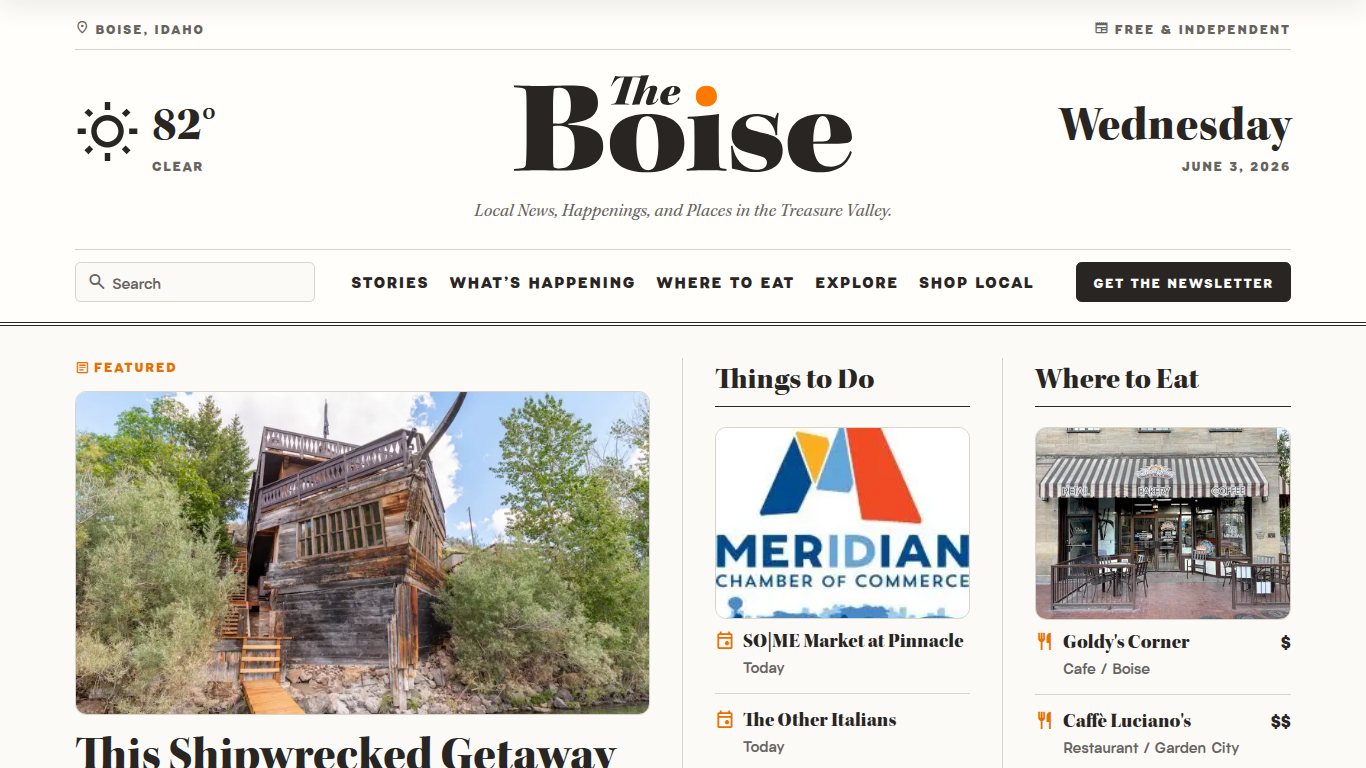
Boise Today is an experiment in local media, AI, maps, and UX. It is probably 85 to 90 percent AI-powered, and the basic idea is to use AI, public data, maps, feeds, and curation to create a local site that feels more useful to someone who actually lives here or is trying to explore the area.
It has stories, events, places to eat, local shops, and things to do. It also pulls together maps for hiking trails, hot springs, campgrounds, points of interest, downtown spots, and other places worth exploring. It has Boise River conditions, which matter here because floating the river is one of those local things people actually care about. If you live in Boise long enough, you learn that river season is not just a minor recreational detail. It is a real part of the rhythm of the city.
The goal is not to replace traditional journalism. I do not have a newsroom. I am not sending reporters to city hall. I am not pretending this is the Idaho Statesman or BoiseDev or any other established local outlet. The goal is different. I wanted to build the kind of local resource I wish had existed when I moved here.
That distinction matters because it changes the whole product.
If the question is “How do we run a traditional local news business?” you will probably end up with a traditional local news website. You will have headlines, categories, ads, breaking news, maybe a newsletter, maybe some event coverage, and a lot of the same patterns that have existed for years.
But if the question is “What would help someone better experience the place they live?” you end up somewhere else entirely.
You end up thinking about maps. You end up thinking about river conditions. You end up thinking about whether someone can quickly find a Saturday market, a downtown restaurant, a trail that is open, or a hot spring they have never visited. You end up caring less about whether something fits the old definition of a news story and more about whether it helps someone understand, enjoy, or navigate the place they live.
That is what makes the project interesting to me.
What This Has to Do With User Experience
I have spent a lot of time designing and building websites, apps, and products, and the phrase “user experience” gets used so often that I think it has become almost meaningless to a lot of people. When people hear UX, they tend to think about button placement, heat maps, click-through rates, rounded corners, conversion funnels, or whether the call-to-action button is the right color.
Those things can matter. I am not saying they never do. But they are not the heart of user experience.
At its core, user experience is much simpler than that. Is this thing useful? Do I like using it? Do I want to be here? Does it make my life better, easier, faster, more interesting, or more enjoyable?
That is the whole game.
The mistake people make is thinking the interface is the experience. It is not. The interface is part of the experience, but the content, usefulness, purpose, and timing are often far more important. A beautifully designed website that does not give people anything they actually want is not good UX. It is decoration. It might win an award. It might look great in a portfolio. But if it does not serve the person using it, then it has failed at the most important part of design.
That is why Boise Today has been such an interesting project for me. The design challenge is not “How do I make a local news site look modern?” That is easy enough. The harder and more important question is “What would make this actually useful to someone in Boise?”
If people here care about hot springs, then a hot springs map is better UX than another generic article about “five things to do this weekend” that disappears into the archive by Monday morning. If people float the Boise River every summer, then live river conditions are better UX than burying that information three clicks deep somewhere else. If someone is new to town and does not know where to eat, then a curated map of restaurants and local spots is not just content. It is part of the product experience.
That is the part I think a lot of websites miss.
Content Is the Product
There is a tendency in web design to separate the container from the content. The designer makes the layout. The developer builds the system. The writer fills in the words. The marketer worries about conversions. Everyone treats their piece as separate, and the final product becomes a bundle of disconnected concerns.
But to the user, none of that separation exists. They do not care whether the issue is design, content, development, strategy, or marketing. They only experience the thing in front of them.
That is why content is not secondary. Content is the product, or at least a huge part of it. On a local website, the experience is not just the navigation menu or the typography. It is whether the site tells you something worth knowing. It is whether the restaurant list is useful. It is whether the trail information helps. It is whether the site understands the local context well enough to feel like it was made for the people who live there.
This is where AI becomes interesting, too. AI makes it possible to pull together, summarize, structure, and reshape information at a scale that would be difficult to do manually as one person. But AI by itself is not the product. It is the machinery behind parts of the product.
The taste still matters. The judgment still matters. The curation still matters. The local understanding still matters.
That is the balance I am trying to strike with Boise Today. Use AI to make the impossible workload more possible, but use human judgment to decide what belongs, what matters, and how it should feel.
Local Should Feel Local
The bigger point is that local media should feel local. That sounds obvious, but I do not think it is treated as obvious often enough.
A local site should not feel like a national template with a city name swapped in. It should not feel like a wire service wearing a Boise hat. It should feel specific. It should reflect the actual interests, habits, places, conversations, and rhythms of the people who live there.
In Boise, that means the outdoors matter. The river matters. Trails matter. Hot springs matter. Downtown matters. Local restaurants matter. Small businesses matter. Events matter. The weird little discoveries matter. The things people text their friends about matter.
Again, that does not mean traditional news does not matter. Of course it does. But the local experience is bigger than the traditional news category. A city is not just its crises, crimes, construction updates, and council meetings. A city is also where people get breakfast, where they walk their dogs, where they take their kids, where they go on dates, where they hike, where they get coffee, and where they spend a lazy Saturday when the weather finally gets nice.
If local media ignores that, it misses a huge part of what makes a place worth knowing.
Why I Built It
So why am I sharing all of this?
Partly because I like sharing what I am working on. I have always enjoyed building things, experimenting in public, and seeing what happens when an idea moves from “that would be interesting” to an actual product someone can click around in.
But the bigger reason is that I think Boise Today is a useful example of what design really is. It is not just the visual layer. It is not just the interface. It is not just whether the site looks polished on a large monitor. Design is the act of serving someone well. It is understanding what they need, what they want, what frustrates them, and what would make their life a little better.
In this case, the person I started with was me. I was new to Boise, I felt clueless, and I wanted a better way to understand the place I had moved to. From there, I tried to think about people who have lived here longer than I have. What do they already enjoy? What do they still want to discover? What information would actually be useful to them?
That is the center of the project.
Boise Today is still early. It is still an experiment. There are plenty of things to improve, polish, rethink, and expand. But I like the direction because it starts from the right question.
Not “How do we make a local news site?”
But “How do we make something useful for people who live here?”
That difference may seem small, but I think it changes everything.